Hunterdon County Roofing
Metal Roofing in Hunterdon County, NJ
Standing seam and metal panel roofing — long service life, excellent snow shedding, suited to rural properties.
Metal roofing suits Hunterdon County's rural character, and not only visually. It sheds snow readily, resists the wind that crosses open farmland, and has a service life measured in decades longer than asphalt.
It is also less forgiving of poor detailing. Metal expands and contracts noticeably with temperature, and a system that does not allow for that movement will loosen its fasteners or distort its panels over time. The fastening method is the main thing that separates a metal roof that lasts from one that does not.
When people call us about this
- Fasteners backing out or their washers visibly degraded
- Panels loosening or rattling in wind
- Rust developing at cut edges, fasteners or panel laps
- Leaks appearing at ridge, eave or wall transitions
- Sealant at seams and flashings that has hardened and cracked
- An existing metal roof, often on a barn or outbuilding, at the end of its life
Standing seam versus exposed fastener
Standing seam systems have concealed clips: the panels are held by fasteners hidden inside the raised seams, so there are no penetrations through the flat of the roof and the panels can expand and contract without stressing the fixings. This is the longer-lived and more expensive option.
Exposed-fastener panels — the corrugated or ribbed profiles common on barns and outbuildings — are screwed through the face of the panel into the structure, with a rubber washer under each screw head. They cost considerably less and install faster, but every screw is a penetration, and those washers are the system's service life. They need periodic attention.
- Standing seam: concealed clips, no face penetrations, longest service life
- Exposed fastener: lower cost, faster installation, washers need periodic checking
- Metal shingles and tiles: panel durability with a profiled appearance
Snow, ice and movement
Metal sheds snow well, which is usually an advantage — but it sheds it all at once, and where a roof discharges over a doorway, a walkway or a driveway that becomes a genuine hazard. Snow guards or retention bars are how that is managed, and they need to be specified at design stage rather than added after an incident.
Thermal movement is the other design constraint. A long metal panel changes length measurably between a January night and a July afternoon, and the system has to accommodate that. Standing seam clips are designed to allow it; on exposed-fastener systems, movement is what gradually works screws loose.
Detailing and the layers beneath
A metal roof still needs a proper underlayment. A high-temperature synthetic or self-adhering membrane goes over the deck, providing a secondary barrier and separating the metal from the sheathing. At the eaves and in valleys, ice and water membrane is as relevant here as it is under shingles.
Transitions — ridge, eave, rake, valley, and any wall junction — are handled with purpose-made trim rather than improvised. Where a metal roof meets a chimney or a wall, the flashing has to accommodate movement as well as shed water, which is why factory trim and proper closures matter more than sealant.
Materials & Components
What goes into the work
Standing seam panels
Concealed-clip panels with raised seams and no fasteners penetrating the flat of the roof.
Exposed-fastener panels
Ribbed or corrugated profiles fixed through the face, common on agricultural buildings.
High-temperature underlayment
Membrane rated for the temperatures reached beneath metal panels in summer.
Snow retention
Guards or bars that hold snow on the roof instead of releasing it in a single slide.
Process
How metal roofing works
The same sequence every time, so you always know what happens next.
Assessment
Structure, pitch, exposure and where snow will discharge are all reviewed before a system is chosen.
System and profile selection
Standing seam or exposed fastener, with profile and colour chosen to suit the building.
Deck preparation
Decking checked and repaired, then high-temperature underlayment and ice and water membrane installed.
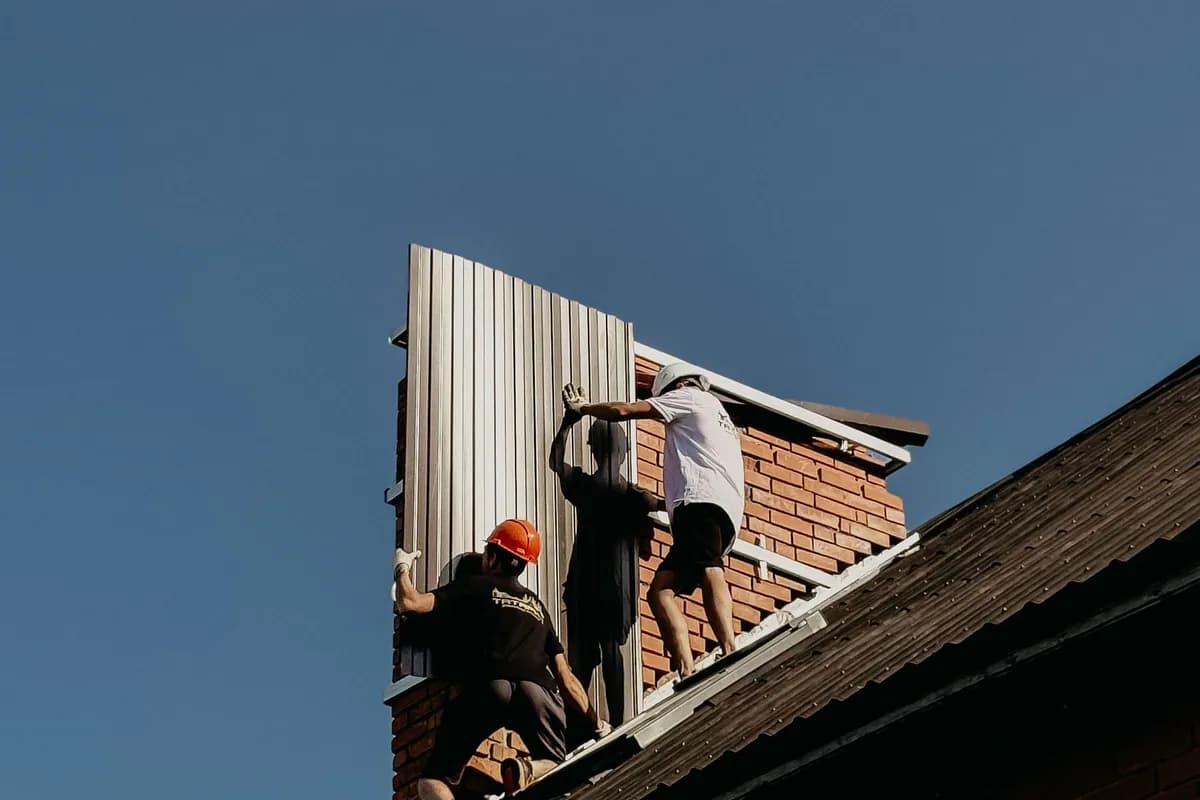
Panel installation
Panels set with clips or fasteners appropriate to the system, allowing for thermal movement.
Trim and closures
Ridge, eave, rake and valley trim installed with proper closures, plus snow retention where discharge is a concern.
Metal Roofing across Hunterdon County
Hunterdon County's building stock varies more than most New Jersey counties, and that changes how this work is approached from one property to the next. A metal roofing job on a nineteenth-century borough house with plank decking and a steep, dormered roof is a different piece of work from the same job on a 1990s development house or on a barn standing in open farmland.
Exposure varies just as much. Properties on the northern ridges and on open farmland take sustained wind, and damage there starts at the rakes, eaves and ridge. River-corridor and valley properties are shaded and damp, dry slowly after rain, and are where moss and organic growth take hold. We assess the property in front of us rather than applying one approach everywhere.
Questions
Metal Roofing questions
Is a metal roof noisy in rain?
Far less than people expect. A metal roof over solid decking, underlayment and an insulated attic sounds much like any other roof from inside the house. The drumming people remember is typically from metal fixed to open purlins on a barn, with nothing underneath it.
Can metal go over my existing shingles?
It is sometimes done, but we generally do not recommend it. Installing over old shingles hides the condition of the decking and the flashing, and it leaves an uneven surface under the panels. Tearing off lets the deck be inspected and the underlayment installed properly.
How long does a metal roof last?
Considerably longer than asphalt — standing seam systems in particular are long-life roofs. Exposed-fastener systems last well too, but their fastener washers are the limiting component and need periodic inspection and eventual replacement.
Will snow slide off onto my walkway?
It can, and that is worth planning for rather than discovering. Where a slope discharges over an entrance, a walkway or a drive, snow retention should be part of the design from the start.
Related roofing services
Roof Installation
New roof systems for additions, new construction and structures that have never carried a finished roof.
Learn moreRoof Replacement
Full tear-off and rebuild of the roofing system, from decking and underlayment through to ridge ventilation.
Learn moreCommercial Roofing
Low-slope and steep-slope roofing for commercial, retail, light industrial and multi-unit properties.
Learn moreRoof Inspection
A documented assessment of covering, flashing, penetrations, decking and ventilation — with a plain-language report.
Learn more
Metal Roofing by municipality
Service-area pages covering the housing stock and roofing conditions characteristic of each place.
Request an Estimate
Request an estimate for metal roofing
Share what you are seeing and where the property is. We will review it and get back to you using the details you provide.
Need metal roofing in Hunterdon County?
Tell us what you are seeing and we will take a look. You will get a clear explanation of what is wrong, what it needs, and what it will cost — in writing.