Hunterdon County Roofing
Roof Installation in Hunterdon County, NJ
New roof systems for additions, new construction and structures that have never carried a finished roof.
Installation differs from replacement in one important way: there is no existing roof to learn from. On a replacement, tear-off tells you how the original assembly behaved, where it leaked and how it was ventilated. On new work, those decisions are made from the drawings and the structure in front of you.
That makes the detailing at the transitions — where the new roof meets an existing wall, an older roof plane, or a change in pitch — the part that deserves the most attention. It is also where new roofs most often develop problems years later.
When people call us about this
- A new addition or dormer that needs to be tied into the existing roof
- A detached garage, barn or outbuilding needing its first finished roof
- New construction reaching the point of being dried in
- A porch or sunroom roof being built where none existed
- A change in roof pitch or structure that needs new covering throughout
Tying new roofs into existing ones
Where an addition meets the original house, the junction has to shed water in both directions and accommodate the fact that the two structures may settle slightly differently. Getting this wrong produces a leak that appears years after the work, and it is almost always at the tie-in rather than in the field of the new roof.
The detail depends on how the planes meet. A new roof running into a vertical wall needs step flashing woven into each shingle course with counter-flashing over it. Where a new plane meets an existing one at a valley, the valley metal and membrane have to run continuously through the junction rather than stopping at it.
- Step and counter-flashing at every new wall junction
- Continuous valley membrane and metal through tie-ins
- Kick-out flashing where a roof edge meets a wall above a gutter
- Matching the existing covering where the new roof is visible alongside it
Decking, pitch and covering choice
The pitch of the new roof determines what can legitimately go on it. Asphalt shingles need adequate slope to shed water; below roughly 2:12 they are not an appropriate covering and a low-slope membrane system is the correct answer. Between 2:12 and 4:12, shingles can be used but require additional underlayment measures.
Porch roofs, sunroom roofs and dormer shed roofs are exactly where this comes up, because they are frequently built at a shallower pitch than the main roof. Specifying shingles on a roof too flat to carry them is a common and avoidable mistake.
Ventilation on new work
A new roof is an opportunity to get ventilation right from the start. Intake at the soffits and exhaust at the ridge need to be balanced and, critically, the intake path has to be clear — insulation pushed tight into the eaves blocks it, and baffles are what keep that channel open.
On additions, it is worth checking whether the new attic space connects to the existing one or is isolated. An isolated space with no intake will not ventilate no matter what goes on the ridge.
Materials & Components
What goes into the work
Roof sheathing
Plywood or OSB decking sized and fastened for the rafter spacing and span.
Transition flashing
Step, counter-, valley and kick-out flashing at the junctions between new and existing structure.
Ventilation baffles
Channels that keep the intake path at the eaves open once insulation is installed.
Process
How roof installation works
The same sequence every time, so you always know what happens next.
Review of drawings and structure
Pitch, spans, tie-in points and ventilation paths are reviewed before materials are specified.
Covering specification
A covering appropriate to the pitch and exposure, coordinated with the existing roof where the two will be seen together.
Written estimate
Scope and materials in writing, including the flashing details at each tie-in.
Decking and dry-in
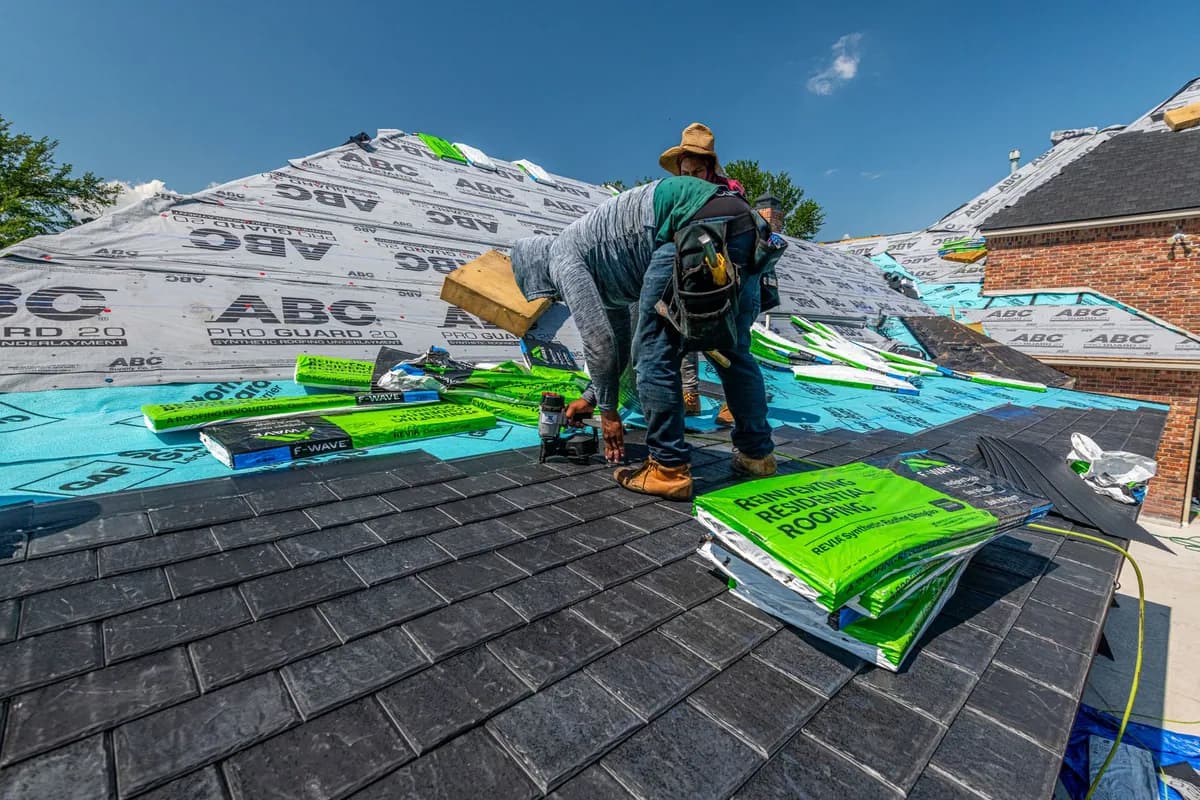
Sheathing fastened, drip edge set, membranes and underlayment installed so the structure is weather-protected.
Flashing and covering
Transition flashing installed first, then starter course, field covering and ridge.
Cleanup and walkthrough
Site cleared, nails swept, and the completed detailing reviewed with you.
Roof Installation across Hunterdon County
Hunterdon County's building stock varies more than most New Jersey counties, and that changes how this work is approached from one property to the next. A roof installation job on a nineteenth-century borough house with plank decking and a steep, dormered roof is a different piece of work from the same job on a 1990s development house or on a barn standing in open farmland.
Exposure varies just as much. Properties on the northern ridges and on open farmland take sustained wind, and damage there starts at the rakes, eaves and ridge. River-corridor and valley properties are shaded and damp, dry slowly after rain, and are where moss and organic growth take hold. We assess the property in front of us rather than applying one approach everywhere.
Questions
Roof Installation questions
Can you match the new roof to my existing shingles?
We try, and on a roof less than a few years old a close match is often possible. On an older roof, exact matching usually is not, because colours are discontinued and the existing shingles have weathered. Where the two roofs will be seen together we will be straightforward about how close the match will be.
What pitch do asphalt shingles need?
Asphalt shingles are generally appropriate down to about 4:12 with standard installation, and between 2:12 and 4:12 with additional underlayment measures. Below roughly 2:12 they are not the right covering, and a low-slope membrane system should be used instead.
Do you work with builders and general contractors?
Yes. On new construction and larger additions we coordinate with whoever is running the project so the roof goes on at the right point in the sequence and the structure is dried in promptly.
Related roofing services
Roof Replacement
Full tear-off and rebuild of the roofing system, from decking and underlayment through to ridge ventilation.
Learn moreAsphalt Shingle Roofing
The most common covering on New Jersey homes — architectural and three-tab shingle systems, properly detailed.
Learn moreMetal Roofing
Standing seam and metal panel roofing — long service life, excellent snow shedding, suited to rural properties.
Learn moreFlat Roofing
Low-slope membrane systems for additions, porch roofs, dormers and commercial buildings.
Learn more
Roof Installation by municipality
Service-area pages covering the housing stock and roofing conditions characteristic of each place.
Request an Estimate
Request an estimate for roof installation
Share what you are seeing and where the property is. We will review it and get back to you using the details you provide.
Need roof installation in Hunterdon County?
Tell us what you are seeing and we will take a look. You will get a clear explanation of what is wrong, what it needs, and what it will cost — in writing.