Hunterdon County Roofing
Roof Replacement in Hunterdon County, NJ
Full tear-off and rebuild of the roofing system, from decking and underlayment through to ridge ventilation.
A roof replacement is not just new shingles. It is a rebuild of a layered system — decking, underlayment, membranes at the vulnerable edges, metal at every transition, the covering itself, and the ventilation that lets the assembly dry out. Each layer depends on the one beneath it.
The quality of a replacement is mostly decided by the parts you will never see again once it is finished. That is why the sequence below matters, and why we walk you through what is being installed at each stage rather than only quoting a shingle brand.
When people call us about this
- Shingles curling, cupping or cracking across more than one roof plane
- Bare patches where the protective granule surface has worn away
- Repeated leaks appearing in unrelated parts of the roof
- A roof deck that looks wavy or dips between rafters
- Shingles that feel brittle and break rather than flex
- An asphalt roof well past twenty years of service
- Multiple layers of shingles already installed
Starting with an inspection, not a quote
Before anything is priced, the roof needs to be looked at properly: how many layers are on it, what the decking is likely to be, how the roof is ventilated now, where the flashing details are, and what condition the eaves and fascia are in. Those findings change both the scope and the cost.
Older homes across Hunterdon County frequently have plank decking rather than plywood, and some have had a second layer of shingles added over the first. Both are normal and both affect the work — plank gaps may need overlay sheathing, and a second layer means more tear-off and disposal.
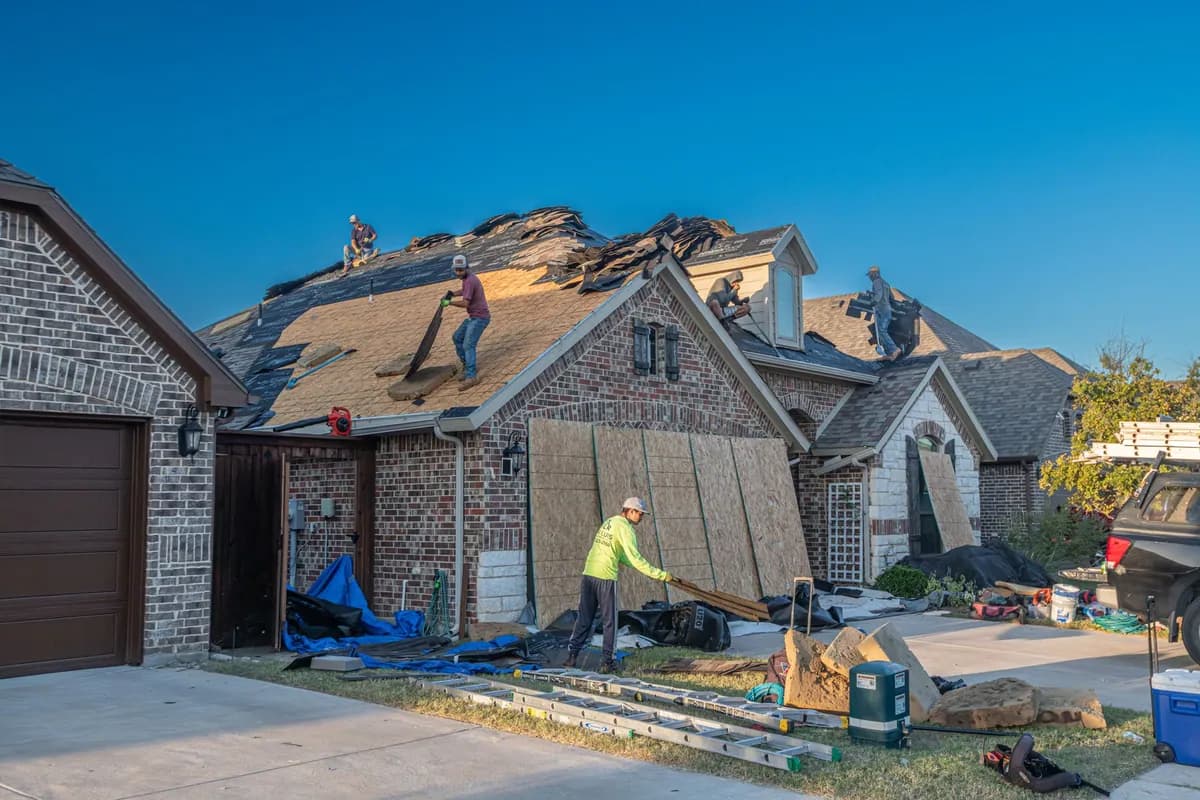
Tear-off and decking
Existing roofing is removed down to the deck. Going over the top of old shingles hides exactly the problems you are paying to have solved: soft sheathing, failed flashing, and a surface that is no longer flat enough for the new covering to lie properly.
With the deck exposed, it can be inspected across its whole area rather than guessed at. Soft, delaminated or water-damaged sections are cut out and replaced with new sheathing, and loose boards are refastened so the deck is solid before anything goes over it.
- Full removal of existing roofing down to the deck
- Sheathing inspected across the whole roof and replaced where unsound
- Loose or lifted decking refastened
- Protection for landscaping and the area around the house
The layers that do the waterproofing
Drip edge goes on first at the eaves, directing water off the deck and into the gutter rather than behind it. Self-adhering ice and water membrane follows at the eaves, in the valleys and around penetrations — the places where water is most likely to be held by an ice dam or forced uphill by wind.
Synthetic underlayment covers the remaining field of the roof as a secondary water barrier beneath the shingles. Then flashing is installed at every transition: step flashing along walls, counter-flashing at chimneys, and new metal in the valleys. Flashing is installed as metal, not improvised with sealant.
- Drip edge at eaves and rakes
- Ice and water membrane at eaves, valleys and penetrations
- Synthetic underlayment across the field
- New step, counter- and valley flashing
- New pipe boots at every plumbing vent
Shingles, ventilation and finishing
A starter course goes on at the eaves and rakes so the first row of shingles is sealed down at its edge rather than left free to lift. Field shingles are then installed in courses with the fastener pattern the manufacturer specifies — nail placement and count are among the most common installation errors and directly affect wind performance.
Ventilation is completed before the ridge caps go on. A roof needs balanced intake at the soffits and exhaust at the ridge so air can move through the attic; a ridge vent with blocked soffits moves very little air. Ridge cap shingles finish the ridge and cover the vent.
The site is then cleared, debris removed, and the ground swept with a magnet for nails. A final walkthrough covers what was installed and what was found along the way.
Materials & Components
What goes into the work
Architectural asphalt shingles
The most common covering on Hunterdon County homes: laminated, dimensional, and available in wind ratings suited to exposed sites.
Synthetic underlayment
A secondary water barrier over the deck, lighter and more tear-resistant than traditional felt.
Ice and water membrane
Self-adhering membrane at eaves, valleys and penetrations that seals around fasteners and resists water backed up by ice dams.
Ridge and soffit ventilation
Balanced intake and exhaust so the attic can dry, which protects both the decking and the shingles above it.
Process
How roof replacement works
The same sequence every time, so you always know what happens next.
Inspection and measurement
The existing roof, its layers, ventilation and flashing details are assessed so the scope reflects the actual roof.
Written proposal
A clear scope covering tear-off, decking allowance, membranes, flashing, covering and ventilation — not just a shingle name and a number.
Scheduling and preparation
Work is scheduled around a suitable weather window, with the property protected before tear-off begins.
Tear-off and deck repair
Old roofing comes off, the deck is inspected across its whole area, and unsound sheathing is replaced.
System installation
Drip edge, ice and water membrane, underlayment, flashing, starter course, field shingles, ventilation and ridge caps, in that order.
Cleanup and walkthrough
Debris removed, a magnetic sweep for nails, and a review of what was installed and what the tear-off revealed.
Roof Replacement across Hunterdon County
Hunterdon County's building stock varies more than most New Jersey counties, and that changes how this work is approached from one property to the next. A roof replacement job on a nineteenth-century borough house with plank decking and a steep, dormered roof is a different piece of work from the same job on a 1990s development house or on a barn standing in open farmland.
Exposure varies just as much. Properties on the northern ridges and on open farmland take sustained wind, and damage there starts at the rakes, eaves and ridge. River-corridor and valley properties are shaded and damp, dry slowly after rain, and are where moss and organic growth take hold. We assess the property in front of us rather than applying one approach everywhere.
Questions
Roof Replacement questions
How long does a roof replacement take?
A typical single-family asphalt shingle roof is often completed in one to three working days, depending on size, how many planes and valleys it has, how steep it is, and how much decking needs replacing. Complex roofs, multiple layers of old shingles or extensive deck repair extend that.
Do I need to be home during the work?
Not usually, though it helps to be available by phone in case something is uncovered during tear-off that changes the scope — soft decking being the most common example. We will always discuss additional work with you before carrying it out.
Should old shingles be torn off, or can you go over them?
We tear off. A second layer hides the condition of the decking and the flashing, adds weight, and traps heat against the new shingles. It also means the next replacement is a bigger job. Removing the old covering is the only way to see and fix what is underneath.
What happens to my landscaping and driveway?
Areas below the work are covered before tear-off begins, debris is contained rather than left to fall where it lands, and the ground is swept with a magnet afterwards to pick up nails. Let us know in advance about anything particularly delicate.
Related roofing services
Roof Repair
Targeted repairs for leaks, wind-lifted shingles, failed flashing and damaged roof penetrations.
Learn moreAsphalt Shingle Roofing
The most common covering on New Jersey homes — architectural and three-tab shingle systems, properly detailed.
Learn moreRoof Installation
New roof systems for additions, new construction and structures that have never carried a finished roof.
Learn moreRoof Inspection
A documented assessment of covering, flashing, penetrations, decking and ventilation — with a plain-language report.
Learn more
Roof Replacement by municipality
Service-area pages covering the housing stock and roofing conditions characteristic of each place.
Request an Estimate
Request an estimate for roof replacement
Share what you are seeing and where the property is. We will review it and get back to you using the details you provide.
Need roof replacement in Hunterdon County?
Tell us what you are seeing and we will take a look. You will get a clear explanation of what is wrong, what it needs, and what it will cost — in writing.