Damage7 min read
How Storm Damage Affects Your Roof
The most common form of wind damage leaves no visible trace. Here is what actually happens and how to tell whether your roof took a hit.
Updated
Serving Hunterdon County, New Jersey
Hunterdon County Service Area
Roofing contractor serving Glen Gardner, NJ. Roof repair, replacement and storm damage work for the borough's hillside and valley properties.
Photo: JERRYE & ROY KLOTZ MD / CC BY-SA 3.0
Glen Gardner is a small borough in the county's north, set in the valley of Spruce Run where the land rises steeply on either side and Route 31 runs through.
The borough's steep, wooded setting shapes its roofing conditions: shaded slopes that dry slowly, mature trees close to buildings, and properties stepped up hillsides where access is not straightforward.
Glen Gardner Borough occupies a compact area in the Spruce Run valley in northern Hunterdon County, with wooded hillsides rising on either side and the village centre along the valley floor near Route 31.
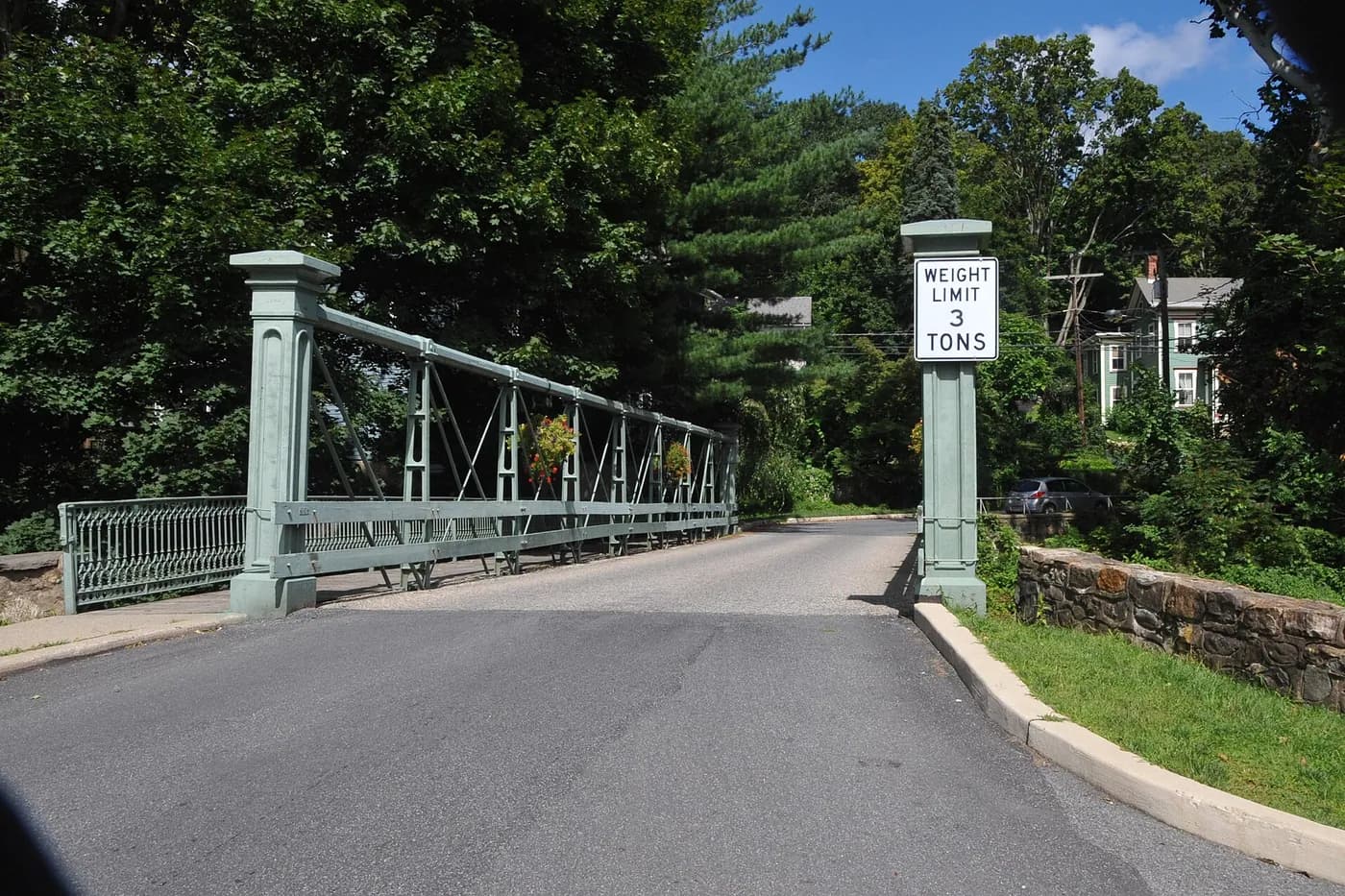
The Glen Gardner pony Pratt truss bridge in Hunterdon County, New Jersey
Photo: JERRYE & ROY KLOTZ MD / CC BY-SA 3.0
Local Building Stock
Housing is mostly nineteenth and early twentieth century in the village core, closely spaced on small lots with steep roofs and plank decking, plus later houses on the hillsides above. Many properties sit beneath mature trees, and several are built into sloping ground so that roof access varies considerably from one side to the other.
Work in Glen Gardner typically involves storm and impact repair, gutter and eave improvements to address ice and debris, and replacement on ageing village roofs.
Seasonal Conditions
Cold air pools in the Spruce Run valley, so the borough experiences the freeze-thaw pattern more intensely than the surrounding high ground, and ice at the eaves is a recurring winter issue. Heavy tree cover keeps roofs shaded and damp and brings limb-fall risk during wind and ice events.
Across the region, winter cycles repeatedly above and below freezing rather than staying frozen. Water works into small gaps, freezes, expands and enlarges them — which is what wears at flashing joints and builds ice at the eaves.
Services
The full range is available here. These are the ones most often needed on local properties.
Targeted repairs for leaks, wind-lifted shingles, failed flashing and damaged roof penetrations.
Full tear-off and rebuild of the roofing system, from decking and underlayment through to ridge ventilation.
Urgent response for active leaks, storm-opened roofs and exposed decking, starting with stopping water entry.
Roofing for houses across Hunterdon County, from mid-century colonials to farmhouses and newer developments.
Low-slope and steep-slope roofing for commercial, retail, light industrial and multi-unit properties.
If your roof is open or actively leaking in Glen Gardner, call (914) 906-5748 rather than waiting on a form, so we can treat it as urgent.
Our Process
The same sequence on every property, whatever the municipality.
Tell us what you are seeing — a stain, a missing shingle, a roof you know is old. Photographs help if you have them.
We assess the roof surface and, where access allows, the attic side, so the diagnosis is based on where water is actually travelling.
A plain explanation of what we found and why it matters, including an honest view on whether repair or replacement is the better use of your money.
Scope, materials and price in writing before any work begins, so you know exactly what is included.
Carried out with the property protected. Failed components are removed and rebuilt rather than covered over, and we talk to you before any scope changes.
Debris cleared, a magnetic sweep for nails, and a review of what was done and what the work revealed.
Neighbouring municipalities we also cover.
Assessment and repair after wind, hail, falling limbs and heavy rain — including the damage that is not obvious.
Learn moreGutters, downspouts and drainage — the part of the roof system that decides where the water actually goes.
Learn moreTargeted repairs for leaks, wind-lifted shingles, failed flashing and damaged roof penetrations.
Learn moreFull tear-off and rebuild of the roofing system, from decking and underlayment through to ridge ventilation.
Learn moreThe most common form of wind damage leaves no visible trace. Here is what actually happens and how to tell whether your roof took a hit.
Updated
The least visible part of a roof system and the one that most often explains why a roof failed early.
Updated
The first hour matters. Here is what to do, what to avoid, and why the stain on your ceiling is not where the water is getting in.
Updated
Questions
It affects access and staging more than the roofing itself. Ladder placement, where materials can be set down and how debris is removed all need planning on a sloping site, and we factor that in when estimating rather than discovering it on the day.
Heat escaping into the attic melts snow on the upper roof; that water runs to the colder eave and refreezes. The valley setting here, where cold air settles, makes it more pronounced. Air sealing, insulation and ventilation address the cause; ice and water membrane at the eaves protects the roof from the consequence.
Not necessarily — but limbs that overhang or touch the roof are worth cutting back. That reduces impact risk in storms, cuts the debris load in gutters and valleys, and lets the roof dry faster after rain.
Yes. We work across all 26 municipalities in Hunterdon County, from the Delaware River boroughs through the central farmland to the northern uplands.
Request an Estimate
Tell us what you are seeing and where the property is. The city field is for your property — it does not need to match the page you are on.
Tell us what you are seeing and we will take a look. You will get a clear explanation of what is wrong, what it needs, and what it will cost — in writing.